Ralph Ingersoll and Father Coughlin

Fr. Coughlin, Ralph Ingersoll & the War Against Social Justice, as originally “printed” at Counter-Currents in late 2018, and more handsomely reproduced at Euro-Synergies, is right here.

Many men, women, boys & girls might prefer to read the whole thing. However, as we deliberately detoured into a talk about Ingersoll and his time at The New Yorker, Fortune, Time, and PM, some key paragraphs might sum it all up for the casual reader:

The public career of Rev. Charles E. Coughlin during the 1930s and early ‘40s is massively documented. Newsreels, publications, speeches, and broadcast recordings are all at your fingertips online. Yet the historical significance of this Canadian-American prelate (1891-1979) is maddeningly elusive. You may have read that he was an immensely popular but controversial “radio priest” with a decidedly populist-nationalist bent, or that he published a weekly magazine called Social Justice (1936-1942), whose contributors included future architect Philip Johnson and philosopher-to-be Francis Parker Yockey.

You may also know that his broadcasting and publishing endeavors were suspended in 1942, soon after American entry into the Second World War. Knowing nothing else, one would assume this was part of the same anti-sedition roundup that netted Lawrence Dennis, George Sylvester Viereck, and others. But in fact the anti-Coughlin campaign was much more focused and sustained, and it originated not from the Justice Department or any other government agency, but from an oddball Left-wing New York newspaper led by one of the most notable editors of the era: Ralph Ingersoll.

Ingersoll

The paper was PM, and for the first two years of its existence (1940-42), it exulted in damning Father Coughlin as a seditionist, a yellow-journalist, a Nazi mouthpiece, and an impious opponent of democracy. PM began with a long series of articles in the summer of 1940. “Nazi Propagandist Coughlin Faithless to Church and Country: Hatred and Bigotry Spread Throughout the Nation by Priest,” screamed one headline.

After American entry into the war, histrionic, full-page editorials by Editor Ingersoll became a regular feature; e.g., one titled “Has Charles Coughlin Lied Again?”

“Time and our mental institutions will take care of his unhappy and misguided followers. But these leaders who have served the purpose of the murderous Adolf Hitler must go . . . Hitler and Coughlin – their lies have been the same . . .” (PM, May 7, 1942)

In March ’42, PM started to print tear-out-and-mail questionnaires addressed to Attorney General Biddle, demanding that the government immediately investigate Coughlin and ban Social Justice from the US postal system. Forty-three thousand of these were mailed in by loyal readers, the paper reported, and soon enough Biddle lowered the boom. PM was cock-a-hoop:

“The Post Office Dept. invoked the 1917 Sedition Act last night to ban from the mail Social Justice, founded in 1936 by Charles E. Coughlin. . . Postmaster General Walker acted on a recommendation from Attorney General Biddle, who informed him that since the war [sic] Social Justice ‘has made a substantial contribution to a systematic and unscrupulous attack upon the war effort of our Nation, both civilian and military.’ ” (PM, April 15, 1942)

Coughlin was threatened with a Grand Jury investigation for sending “seditious propaganda” to military personnel and munitions workers! Eventually, an agreement was reached between Justice and the bishop of Detroit, whereby Coughlin would cease publishing and public speaking and slip off quietly to his rectory.

Which, as it happens, he did.

The Paranoid Style in Michiko Kakutani

In this past Sunday’s print edition, the New York Times’s former book reviewer Michiko Kakutani treated us to a 3,000-word summary of everything that’s wrong with American life and politics, entitled “The End of Normal” (December 29, 2019).

At least, the column is attributed to Ms. Kakutani, and carries her byline. Actually this farrago of nonsense looks like something a committee of ghosts might produce if asked to flesh out eight or ten talking points from Media Matters for America. We get such laughable clichés as:

  • Lin-Manuel Miranda’s dazzling 2015 musical “Hamilton” . . . embodied the hopes and diversity of America during the Obama years . . .
  • Fear and distrust are ascendant now. At home, hate-crime violence reached a 16-year high . . .
  • Mr. Trump has . . . cruelly amplified existing division and resentments in America . . . fueling suspicion of immigrants and minorities and injecting white nationalist views into the mainstream, in efforts to gin up his base.
  • With his calls to “Make America Great Again,” Mr. Trump appealed to… nostalgia for an era when white men were in charge and women, African-Americans, Hispanics and immigrants knew their place.
  • The president’s hard-core supporters . . . repeat lies and conspiracy theories . . . connecting him with Russian trolls, white nationalists, and random crackpots . . .
  • Without commonly agreed-upon facts, we . . . become susceptible to the fear-mongering of demagogues.
  • It was fitting . . . that in January 2017 . . . George Orwell’s classic novel “1984” shot to the top of best-seller lists. The nearly 70-year-old novel suddenly felt unbearably timely . . .

But for my money, the giveaway that this piece is a derivative and collective effort is the author’s (or authors’) invocation of the 1964 Richard Hofstadter essay, “The Paranoid Style in American Politics.” This is one of those famous screeds whose title is often cited, though the text is seldom read, let alone critiqued. Published in Harper’s on the eve of the LBJ-Goldwater election (November 1964), “Paranoid Style” was one of a number of smear pieces targeting the Right-wing that season. Another famous one was Ralph Ginzburg’s libelous takeout in Fact magazine, more or less claiming that nine out of ten leading psychiatrists agreed that Barry Goldwater was too mentally ill to be President.

The Hoftstadter essay is about 6,000 words of Lefty pabulum. It begins with a quick survey of random “conspiracy theories”—about the Illuminati, the Masons, the Jesuits—then finally circles close to home by indicting the sort of Rightist nuts and apostate Communists who ranted about the “alleged conspirators headed by Alger Hiss.”

The Paranoids are that way, explains Hofstadter, because they feel “dispossessed” and they need to find scapegoats. “America has largely been taken away from them . . . The old American virtues have already been eaten away by cosmopolitans and intellectuals . . .” [1]

And who are these “cosmopolitans and intellectuals,” do you think (wink-wink)? Hofstadter doesn’t go into that. He does goes on and on about Robert Welch and the Birchers, and McCarthyism, and obscure anti-Catholic divines from the early 1800s, but never tells us what’s really on his mind. But not to worry; his fans were savvy. As such folk liked to boast, they could “read between the lines.”

Hofstadter was a name-brand history professor at Columbia for many years. If you don’t know the name, you can place him in context if you know that of his protegés was your favorite Red Diaper Baby and race-hustler, Eric Foner.

The 1964 essay is such gaseous, evasive blather that I always marvel when someone cites it as though it were a landmark in political philosophy. But people still do; “Paranoid Style” has a cool title and its fame precedes it. So the Kakutani column invokes it as gospel, and instructs us that there are murky-minded conspiracy theorists out there, and these are the true villains in the story:

Although the United States was founded on Enlightenment values of reason, liberty and progress, there has long been another strain of thinking at work beneath the surface—what Philip Roth called “the indigenous American berserk,” and the historian Richard Hofstadter famously described as “the paranoid style.”

It’s an outlook characterized by a sense of “heated exaggeration, suspiciousness, and conspiratorial fantasy,” Hofstadter wrote in his 1964 essay, and focused on perceived threats to “a nation, a culture, a way of life.” Its language is apocalyptic (Mr. Trump’s “American carnage” is a perfect example); its point of view, extremist. It regards its opponents as evil and ubiquitous, while portraying itself, in Hofstadter’s words, as “manning the barricades of civilization.” . . . The paranoid style, Hofstadter observed, tends to occur in “episodic waves,” The modern right wing, he wrote, feels dispossessed . . .

And on and on we go, through the business I quoted earlier about how “America has largely been taken away . . . by cosmopolitans and intellectuals.”

It’s stating the obvious to point out that the delusional ones here are Kakutani and her ghostwriters, and the organizations that feed them their talking points. Or perhaps they’re not delusional at all; they’re lying out of convenience, laying the party line on as thick as they can. They know perfectly well that the sudden popularity of Orwell’s 1984 wasn’t because millions of people believed Donald Trump was Big Brother. It was because the bookshops were suddenly laying big stacks of the novel on their display tables, at the same time that the book was being talked up in the mainstream press. If there was a Big Brother entity in play, it was clearly the Fake News machine at CNN and the Washington Post.

Regardless of who wrote this column, “The End of Normal,” it wasn’t done from scratch. It’s largely a précis of Kakutani’s 2018 book, The Death of Truth: Notes on Falsehood in the Age of Trump. [2] There the author or authors had a lot more elbow-room, and scattered innuendo around like confetti. The book reads like a parody of the whole anti-Trump genre. We still get Richard Hofstadter, and Philip Roth, and Trump-Is-Big-Brother, and Russian Trolls Stole the Election. We also get imagined endorsements from Yeats (“Things fall apart,” yada-yada) and Margaret Atwood and Pat Moynihan and Pope Francis and—Heaven help us—even Tom Wolfe.

Just so you know what the book is really all about, the Introduction opens up with Hannah Arendt in The Origins of Totalitarianism:

The ideal subject of totalitarian rule is not the convinced Nazi or convinced Communist, but the people for whom the distinction between fact and fiction…and the distinction between true and false…no longer to exist.

What’s alarming to the contemporary reader is that Arendt’s words increasingly sound less like a dispatch from another century than a chilling mirror of the political and cultural landscape we inhabit today—a world in which fake news and lies are pumped out in industrial volume by Russian troll factories…

Industrial volume, comrade!

And now we must switch gears and talk about how this is all a big change of course for the Kakutani brand. In 2017, like many old-timers at the Paper of Record, she took a buyout from the New York Times. She’d been with the paper for 38 years, most of them reviewing books. She was sometimes noted for her cranky opinions, especially toward the end, but at no time was she a strident Lefty, or any kind of politico.

She was noted early on for her sharp-eyed but easy-flowing critical prose, and so succeeded to the role of lead book reviewer quite young, when she was only eight or nine years out of Yale. Michi was young and different, not an academic or mossy book editor, equipped with a magpie curiosity that must have given her a range of insights inaccessible to such old warhorses as Christopher Lehmann-Haupt. And let us not discount the novelty factor. You saw the name Michiko Kakutani, and you didn’t forget it.

Her reviewing style was quite amiable at first. She mainly covered new fiction, in the same chirrupy idiom that publishers use in press releases and cover blurbs. It was very important in those days to be upbeat and positive when reviewing at the Times. People still laughed grimly over the Legend of Renata Adler. Adler was a tough young movie reviewer in the late 1960s who’d taken a hatchet to every film. “We need positive quotes, Renata, things they can put in the movie ads,” her editors supposedly admonished her. In those days there was a movie house on every block of Midtown, and the Sunday Times ran six or seven pages of display ads for the local cinemas. Renata didn’t care. After a year she got the boot.

But as the calendar pages fell off the wall—ten years, fifteen, twenty—young Michi gradually moved into Dale (“Hatchet Man”) Peck territory. She started mocking the latest offerings, chopping away just to get a rise out of people. Jonathan Franzen, you odious jackass! Slam, bang, take that, Harry Potter! Shut up, Norman Mailer, you garrulous, self-absorbed old man! Nassim Nicholas Taleb, you pompous, pretentious bully!

It appears she was at her most hatchety in her non-fiction reviews, perhaps because in such cases you actually have to read the book and engage with its thesis; you can’t get away with just extrapolating from the press release, the way reviewers do in LA or DC.

In the last decade of her hitch, Michi’s output sometimes got totally loopy. She would write reviews in the “voice” of Holly Golightly or Holden Caulfield. When she reviewed a biography of Adolf Hitler by Volker Ullrich in 2016, she described Adolf as Donald Trump, as imagined by the fever-swamp Left:

  • Hitler was often described as an egomaniac who ‘only loved himself’ — a narcissist with a taste for self-dramatization and what Mr. Ullrich calls a ‘characteristic fondness for superlatives.’
  • A former finance minister wrote that Hitler ‘was so thoroughly untruthful that he could no longer recognize the difference between lies and truth’ and editors of one edition of Mein Kampf described it as a ‘swamp of lies, distortions, innuendoes, half-truths and real facts.’
  • Hitler increasingly presented himself in messianic terms, promising ‘to lead Germany to a new era of national greatness,’ though he was typically vague about his actual plans.

Clearly she was having too much fun with this. Maybe she was getting bored. In The Naked Civil Servant, Quentin Crisp recalled how he once had a job as an engineer’s tracer, siting electrical pylons across a map of the countryside. Just for fun, he began to place the pylons in people’s back gardens, in schoolyards and football pitches.

I wonder if Michi has been doing something along those lines in the last couple years, parodying Leftist cant with such exact phraseology that no one’s rumbled her yet. If that’s the case, I really must reconsider my theory that her recent, politically freighted stuff is being concocted by a tableful of ghostwriting gnomes.

“Industrial volume Russian troll factories” may be the giveaway here. How long, you think, before they find her out?

Notes

[1] Richard Hofstadter, “The Paranoid Style in American Politics,” Harper’s, November 1964.

[2] Michiko Kakutani, The Death of Truth: Notes on Falsehood in the Age of Trump. New York: Tim Dugga

Memories of a Cupcake Bandit

Document thief Barry Landau got a raw deal in 2012—from the press, the judge and Rod Rosenstein.

From the Federal Correctional Center in sunny Lompoc, California comes news that my old pal Barry Landau has been released. Oh wait—not quite. It turns out he’s just been transferred to a halfway-house in Riverside, and has a few months left on his bid.

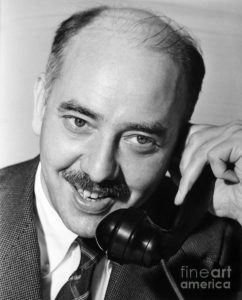
This semi-prison is one of those private-contractor outfits that specialize in rehab and prisoner “re-entry,” but strangely enough (and unlike the Federal pens) it doesn’t let its wards use e-mail. So Barry and I are playing telephone tag right now and soon I’ll know when he’s getting out.
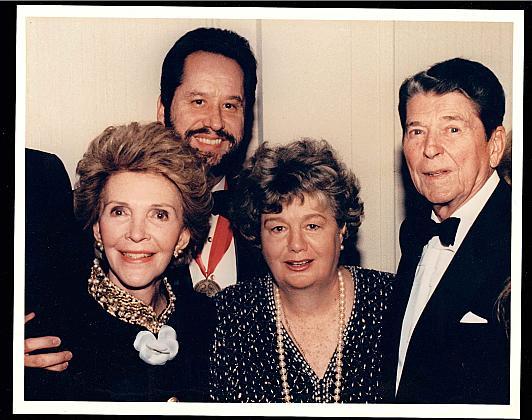
 

Barry Landau, you will recall, is the White House party animal and self-styled “Presidential Historian” who got arrested in Baltimore in 2011 while he and an accomplice were filching archives from the Maryland Historical Society. The Baltimore documents weren’t terribly exciting—e.g., 1881 presidential Inauguration programs. But then a Federal raid on Barry’s apartment in New York turned up a trove of choicer nuggets, lifted from a half-dozen historical libraries. A letter from Ben Franklin, an inscribed volume from Karl Marx, a note from Marie Antoinette, the autograph of Christopher Columbus.

That made it more than small-time local museum theft. A federal case was opened, by none other than Rod J. Rosenstein, now U.S. Deputy Attorney General, but then the U.S. Attorney for Maryland.

Barry and his young accomplice, Jason Savedoff, had a routine. They’d research an institution’s holdings online and draw up a wish-list. Then they’d show up, wreathed in smiles and bearing a plate of cookies or cupcakes for the library staff. Barry would schmooze personnel and distract them, while Jason pocketed precious paper.

The usual ruse was that Barry would show up at a library or museum and announce himself as an historian researching a new book. This seemed  plausible. A few years earlier, Barry had published a lavish coffee-table book about White House banquets (The President’s Table: 200 Years of Dining and Diplomacy), and this got him appearances on C-SPAN, 60 Minutes, Martha Stewart, Today Show, etc. etc., as an erudite foodie-historian. Nevertheless his CV was odd for an scholar—“America’s Presidential Historian,” his website proclaimed him. He’d spent most of his career as a celebrity publicist.

Eight or nine years ago, when I was at Food & Wine magazine, I became aware that this neighbor of mine had somehow reinvented himself as a fine-dining expert. Sometimes I’d see him in our apartment building’s elevator or lobby, dressed in a souvenir roadie jacket from some Clinton Administration beano. “So you know Bill Clinton, then?” I asked.

“I’ve known lots of Presidents. Almost every one since Eisenhower!”

  *   *   *

It was during Barry’s second visit to Baltimore (July 11, 2011) that a Maryland Historical Society staff member got suspicious and called the cops. Police and staff found up sixty MHS documents in a museum locker. The next day, they raided Barry’s New York apartment.

Initially the press treated it all as a big joke, a man-bites-dog story. “At the Maryland Historical Society, they’re calling it the Great Cupcake Caper,” wrote the Baltimore Sun (July 12, 2011). “Before being arrested by police on Saturday and charged with stealing dozens of historical documents, author and collector Barry H. Landau had brought cupcakes for the center’s employees. They figure he was trying to ingratiate himself with the staff, much as he has for decades with political and Hollywood elite.”

Indeed, the Cupcake Bandit had been a demi-celebrity for most of his life. Barry Landau turns up, Zelig-like, in old news and stock photos, with George Hamilton, Cheryl Tiegs, Tom Selleck, Patricia Neal, George Plimpton, the Bushes, the Reagans. Andy Warhol mentions him 20 times in his Diaries, usually rather sniffily. (“Barry Landau, that creepy guy we can’t figure out, who somehow gets himself around everywhere with every celebrity.”)

NY Times, 1979

In 1979 Barry’s picture was in the New York Post and NY Times for grassing on Hamilton Jordan, President Jimmy Carter’s chief of staff. Barry claimed to have seen him trying to score cocaine at Studio 54. This led to grand jury investigations in which 30-year-old Barry was a star witness, under the guidance of a bushy-haired young attorney named Andrew Napolitano.
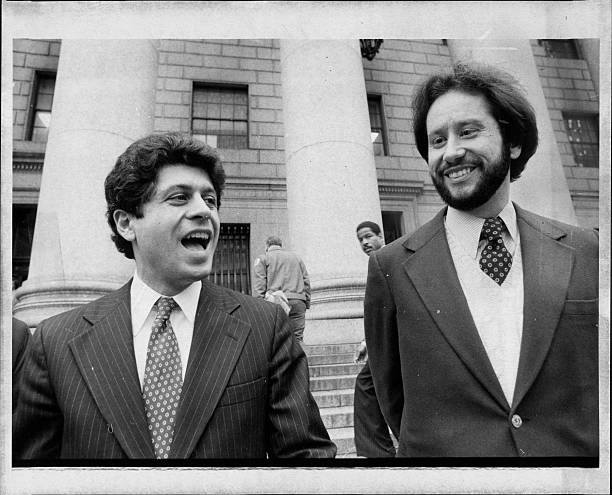
But could Barry Landau really, truly be the mastermind of the Cupcake Caper? That looked unlikely at the outset. His lawyers denied it. They said Jason Savedoff was to blame. They portrayed the 24-year-old “aspiring model” from Vancouver BC as a persuasive, greedy Svengali. Savedoff had wormed his way into Barry’s confidence, and then used “America’s Presidential Historian” as a front-man to gain access to valuable archives. Unlike Barry, Jason wasn’t interested in history, or presidents; he just wanted to steal a lot of autographs and make a lot of money.

But as the months rolled on, the media soured on Barry, and convicted him in the press long before the trial date. On TV and in the newspapers they’d show old file photos of him beside his vast horde of presidential memorabilia—acquired honestly over a half-century, ever since he first met Ike and Mamie Eisenhower in the 1950s—and insinuate that his 17th-storey corner apartment was an Ali Baba’s cave of stolen archives.

They’d write that Barry had grossly exaggerated his experience as a publicist and White House event manager. Famous names got phoned up for snotty comments. (“He was a name-dropper,” sniffed Barbara Bush.) And inevitably such outlets as The Daily Beast would speculate snarkily about the nature of the relationship between Landau and Savedoff.

Thus in the end it was Barry who got a ten-year sentence (7 years prison, 3 probation), while pretty young Jason got off with a slap on the wrist (one year in prison). At his trial in Baltimore, Jason’s attorneys drew a portrait of a pathetic, mentally ill youth who believed “conspiracy theories”; a naive kid who got hoodwinked by a worldly old reprobate.

This “victim” argument was probably inevitable; it’s an accusation that requires no proof, as was illustrated recently with the lurid, ludicrous rape tales aimed at Justice Brett Kavanaugh; or as we keep seeing over and over with the ancient, transparently fake “clerical abuse” stories.

But the Jason-as-victim argument looked brazen and presposterous. It came at the end of many months in which the consensus among press and prosecutors was that Jason Savedoff was a pathologically dishonest male hustler.

Barry’s sentence amazed me. How in hell does a 63-year-old first-time offender get a ten-year sentence for a non-violent crime? A crime, ladies and gents, in which most of the stolen goods were recovered—and (a crucial but overlooked point) had little historical significance. Most of them were ephemera—tickets, programs, cartes-de-visite—or autographed letters from the junkier end of the antiquarian world, the equivalent of a baseball signed by Mickey Mantle.

You don’t send an old guy to prison for seven years because he was an accomplice in the theft of a mint 1940 copy of Batman Comics #1.

At Studio 54 with Phyllis Diller, 1979.

Did Barry have the worst legal representation in the world? I don’t think so. I think Barry and his counsel got conned. Rosenstein’s office did a bait-and-switch on them.

When the case began, Barry could have had a jury trial. He could even have pled not guilty because of extenuating circumstances.

Rosenstein’s office didn’t want that. That would be blaming the thefts on Jason Savedoff, and Jason Savedoff’s testimony was the whole foundation of their case. His allegations would never have stood up under cross-examination.

And so Rosenstein’s office . . . lied. The prosecutors offered Barry a deal: they promised leniency if he pled guilty, and waived that jury trial, with right of appeal. They told him the trial would be over quickly, and that Barry wouldn’t have to serve much time in prison.

And then, instead of giving Barry a suspended sentence or maybe a year (like Jason) they threw the book at him. And he couldn’t even appeal the verdict, because he signed that away when he signed the plea agreement.

Is there a murky backstory to all this? Did Rod Rosenstein have some personal interest in the case, perhaps on behalf of a friend? I don’t know, but his discussion of it was most peculiar and bespeaks a personal grudge. On television and in press releases, he repeatedly referred to Barry as a “con man” or “con artist.” Here he is announcing the verdict in 2012: “Barry H. Landau was a con artist who masqueraded as a presidential historian to gain people’s trust so he could steal their property.”

A con artist? There was no con or flim-flam involved here. Barry wasn’t taking people’s money for swampland deeds or forged documents. He didn’t masquerade as “presidential historian Barry Landau,” that is who he really was, with a big book and everything!

If he did in fact steal or misappropriate original documents . . . okay, that is not a transgression unknown among professional historians. But that’s not being a flim-flam man.

Rod Rosenstein’s choice of words is revealing. It suggests that Barry Landau’s real crime was not helping Jason Savedoff steal historical bumpf, rather it was having been a show-off, a social-climber, a celebrity hanger-on, a name-dropper (yeah; as Mrs. Bush said). The kind of person who would crash Andy Warhol parties and boast about seeing Hamilton Jordan try to buy cocaine.

Of course there might be some other, specific offense from the olden days that Barry had to be punished for. I just don’t know yet, dear readers. But I think it’s pretty safe to say he wasn’t sent on a long prison stretch just for lifting some ephemera from museums.
American Girl Dolls Adds a New Doll That’s Actually an American Girl
(But it’s a Taylor Swift avatar.)

Article in vDare.com.

Abstract: After a decade or more of intense Diversification, American Girl Dolls actually added a (white) American girl to its lineup this year. Alas, it’s just an imitation Taylor Swift named Tenney Grant.
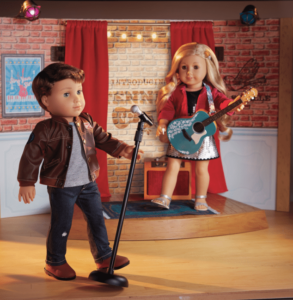

Meanwhile, the tawdrification and mongrelizing of this once-stellar franchise, now owned by Mattel, goes on apace. Read the whole story.

Wee Bobby Baker

Yes Wee Bobby Baker will be returning to Podsnap’s Own, after an absence of decades. We all wish him well.

Hello world!

Welcome to WordPress. This is your first post. Edit or delete it, then start writing!

Share
Don't Share